Cat Leather Jackets
A musical visual novel about a teenage punk rock band.
- game design
- localization
- marketing
- narrative design
- pr
- production
- project management
- publishing
- qa
- social media
- ui/ux
- writing

A game by Diana Amorim, responsible for the original concept, music, and programming, in partnership with Garoa Studios, responsible for production, publishing, narrative, QA, and marketing, and Kuating, responsible for the art.

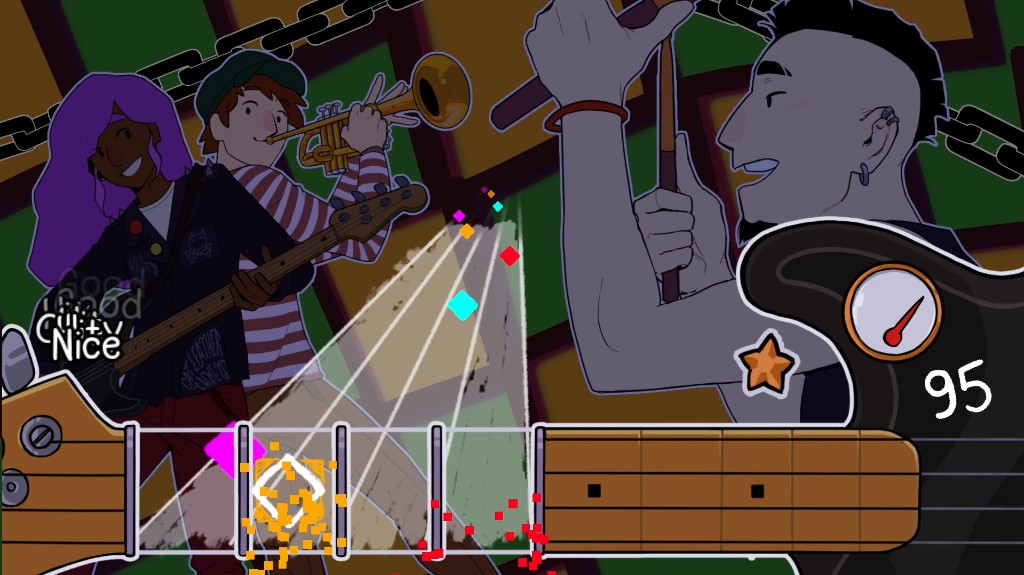
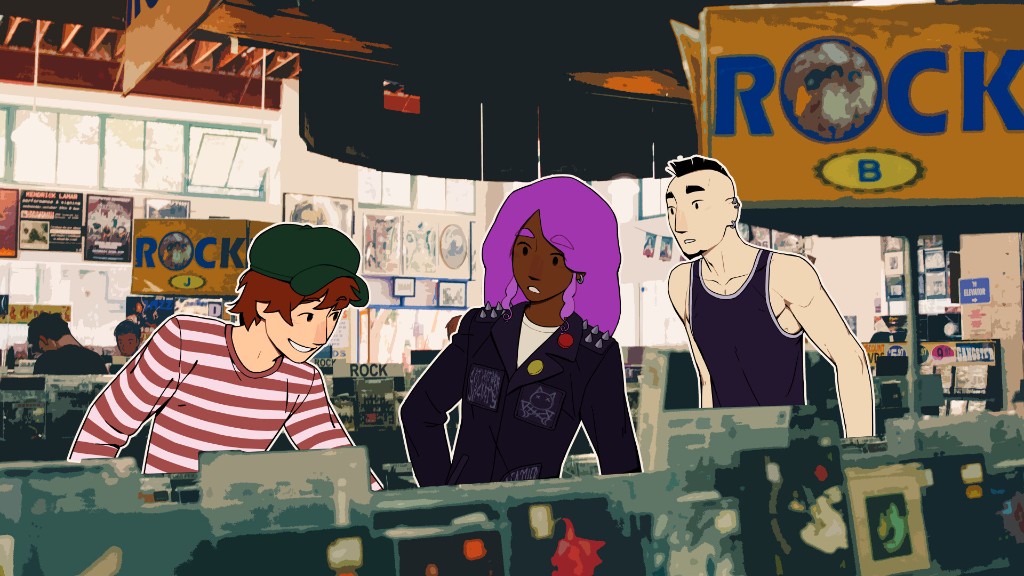
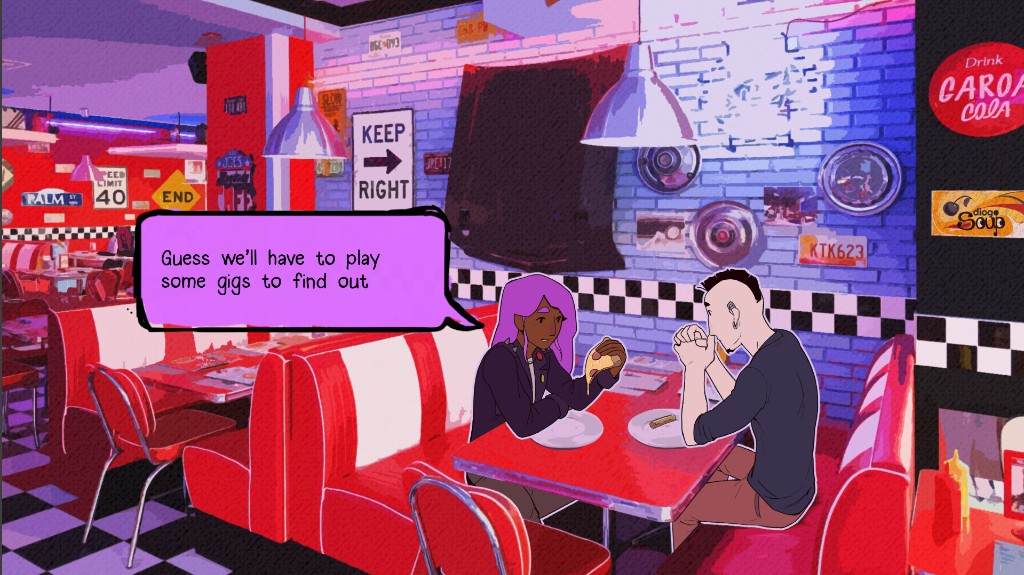
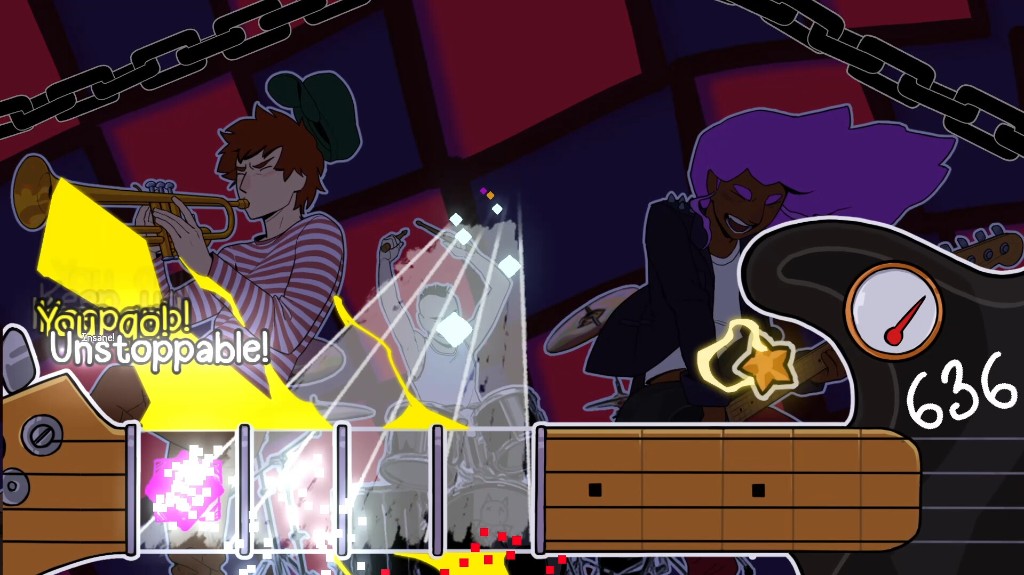
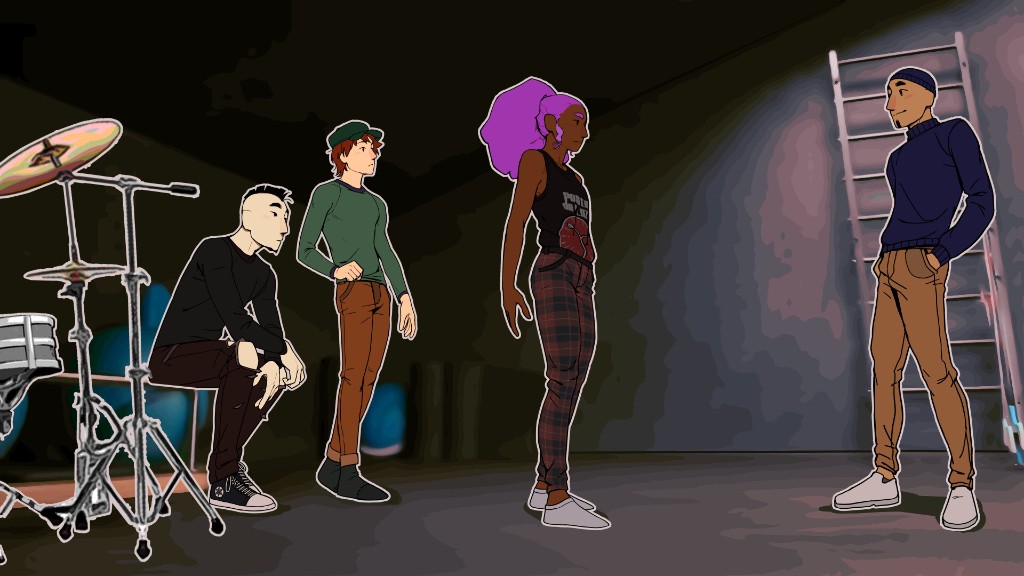
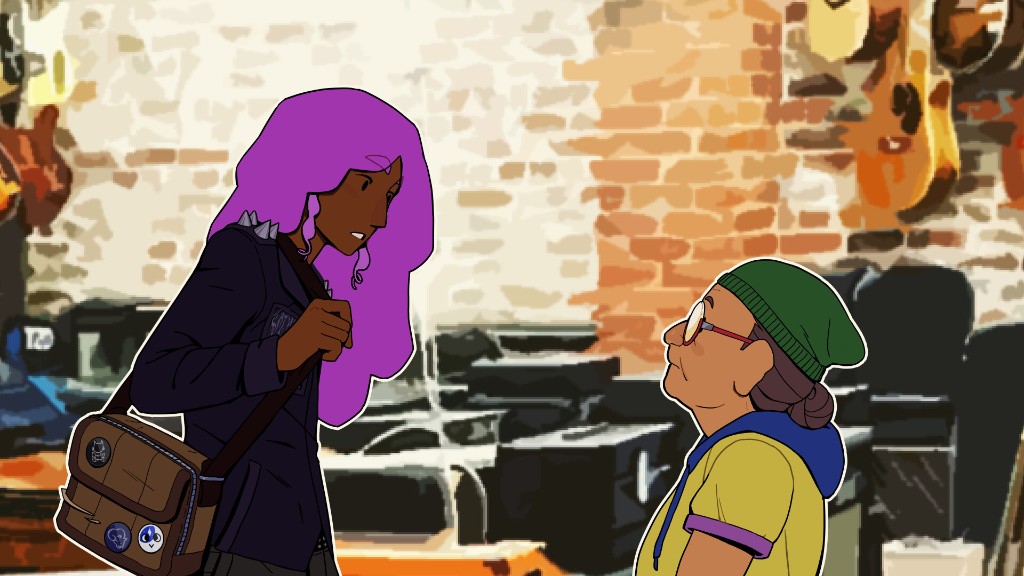
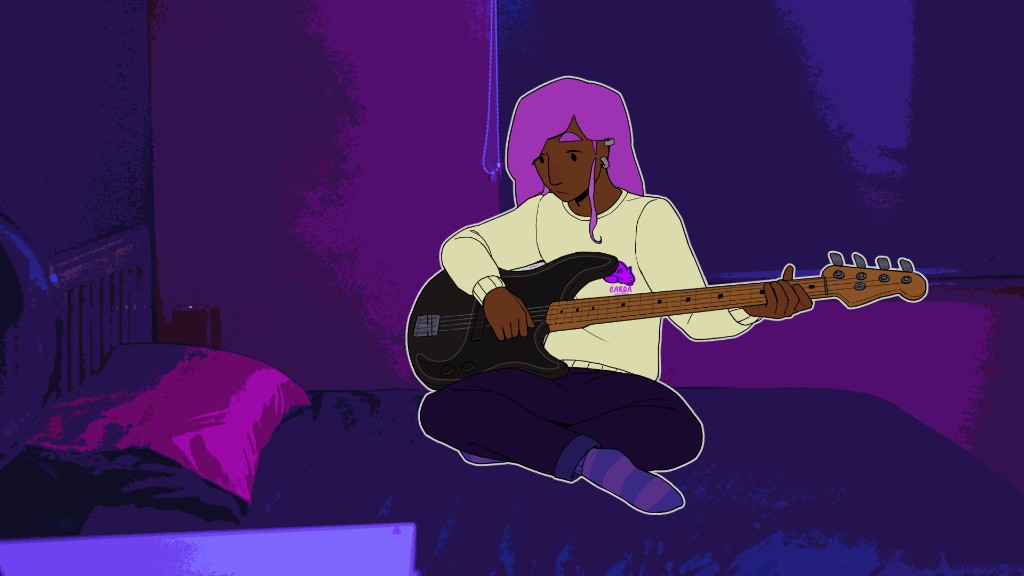
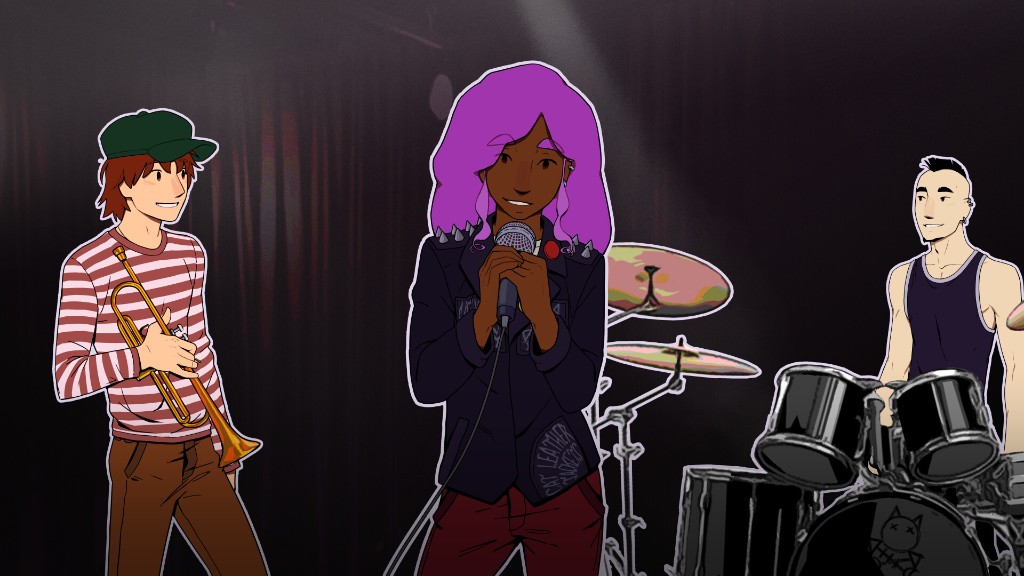
My first contact with the Cat Leather Jackets project was while I was still part of GDP UFRJ, a university game development group I had been involved with for around four years.
I was already in my final months with the group, after spending a lot of time working across management, coordination, project and people management, finance, marketing, organizing jams and selection processes, and institutional partnerships (pretty exhausting). I had been doing a few closing presentations, wrap-ups of my time there, almost like a postmortem of that whole period. It was in one of those meetings that the project was officially presented by someone who was part of the group at the time, Diana. At first, I have to admit, it didn’t really catch my attention that much - every week we saw new projects being presented, and very few of them continued.
The original idea, even though it was already a ska punk rhythm game with a narrative, involved a much more complex kind of interaction: gameplay built around more than a dozen different buttons, inspired by Receiver, a shooting game in which actions that are usually simplified in videogames, like reloading a gun, cocking it, aiming, and shooting, are broken down into several separate commands in an attempt to emulate some of the complexity of real life. In this first iteration, CLJ’s many buttons were meant to actually emulate someone positioning their fingers on the neck of a guitar/bass in order to play notes and chords.
Over the following months, after I had already left the group, Diana reached out to me a few times asking for some consulting on the project’s narrative. She already had the vision that it shouldn’t be “just” a rhythm game, but should also have dialogue scenes and a structure somewhat close to a visual novel. Since she knew I already worked with narrative, had written commercial games, and had made visual novels before, she started asking me for some resources and direction. At a certain point, we both realized it had already become more than consulting, and it made more sense to formalize my full involvement in the project: I was already getting my hands dirty writing and doing narrative design.
After some time collaborating directly with her, I brought the project to Garoa and presented the idea to the other partners at the time (Carol, Piêr, Igor, and Raposo). My proposal was that we try an experiment, a kind of soft publishing arrangement, a co-publishing deal for Cat Leather Jackets. Garoa would publish the game on Steam and take on part of the responsibility for the project: marketing, productization, publishing, and all the direction necessary for someone who had never commercially released a game before, in exchange for a share of the royalties. The discussion went back and forth, but eventually we closed the partnership, and Cat Leather Jackets joined Garoa’s catalog.
Not long after that, I reached out to another partner of ours, Rafael de Aguiar (Kuating), to redo the sprites and part of the project’s visual identity. The original art had been made by Diana herself and had a lot of charm, with a kind of zine aesthetic. But after talking it through, we came to the conclusion that it might be difficult to market and productize the game exactly in that form, considering that the Steam audience is somewhat more ‘demanding’ (and less tolerant of what it perceives as ‘amateur’). Rafael, who is very dear to us, was working with me on another project at the time. We paused that work and he moved onto Cat Leather Jackets full-time, with the task of preserving as much as possible of Diana’s style and the charm of the original version, while taking the art to a higher level of polish, drawing on the professional experience he already had from several years working specifically with illustration and animation. The final result turned out really great, and we managed to preserve the character design and practically everything that made CLJ feel like Diana’s game, but with a much more polished presentation.
In the meantime, besides working on the narrative, I also worked as the project’s executive producer: acting as the bridge with Garoa, handling publishing, contractual and financial matters, Steam, and marketing – at the time we also had a social media intern at Garoa, who dedicated part of his time to creating assets, posts, videos, and other content for the game; we organized a launch livestream, and published the OST on YouTube and Spotify – and I also worked on UX, suggesting to Diana some new quality-of-life features, accessibility options, and general direction around interface, game feel, and juice.
There was also an important process of simplifying the interaction from the original concept, the one with the multiple buttons. It was very experimental, and we liked the challenge, but after a few playtests we realized it would be very difficult to put it in front of a broader audience in that form. So we moved in a direction a little closer to Guitar Hero, although even simpler. This ended up lowering the game’s rhythmic demands quite a bit, so even though it is categorized as a rhythm game, internally (between us at Garoa and Diana), we see CLJ more as a narrative game with rhythm sections.
On the narrative side, we also made an important decision to preserve that zine and comic-book aesthetic: not to include choices or a branching narrative, and instead go with what is usually called a kinetic novel, a linear narrative. We wanted to tell one specific story, Priya’s story. I wrote the complete narrative of the final game in English and Brazilian Portuguese, using what Di had already written as a tonal foundation, along with the story she wanted to tell and the themes she wanted to bring into it. From there, I developed, expanded, and structured it, always validating things with her. I worked on the characterization of the cast, the world they were part of (strongly inspired by the Flamengo - Laranjeiras - Cosme Velho axis in Rio de Janeiro, where both Di and I were living at the time), created new characters, and took the prototype she had, with around four or five scenes, to the more than 30 scenes present in the final game.
Despite a long production cycle - due to working in parallel with other Garoa projects, my moving house, a few months spent caring for and, unfortunately, eventually losing a sick kitten I had adopted, and an entire semester in which Di went on hiatus while spending a period of university in Finland through the Magalhães Network - the game was released in December 2023, selected for exhibition at several events and official showcases, received positive media coverage, appeared on podcasts, and earned a Very Positive rating on Steam. At the time of writing this post, it may still be one of the very few ska punk rhythm games out there.
It is also worth highlighting that all of the music was made by Di herself (with some composition consulting from Piêr), mostly using virtual instruments, but with some tracks also incorporating acoustic instruments recorded by her band.
- discord
- godot
- google sheets
- photoshop
- premiere
- sns
- telegram
I worked across game design, narrative design, production, UX, publishing, marketing, and business, helping take the project from an early student prototype to an award-winning commercial release.
On game design, I helped simplify the original multi-input rhythm system after playtests, rebuild beatmaps, tune difficulty, and define supporting features such as Practice Mode, scoring, combos, accessibility options, and general quality-of-life improvements.
I led the narrative design and writing, expanding the original prototype into more than 30 scenes and writing the complete final script in English and Brazilian, including characterization, worldbuilding, dialogue, structure, and editing.
As executive producer, I handled scope, scheduling, collaborators, playtesting, quality review, publishing coordination, contractual and financial matters, Steam release preparation, and the bridge between Diana, Kuating, and Garoa.
I also coordinated marketing and PR, including social media, promotional assets, launch activities, press outreach, wishlist building, soundtrack distribution, and submissions to festivals, showcases, and competitions.
- Official selection for gamescom latam BIG Festival 2024
- Official selection at Perifacon 2024
- Selected as one of the Best Brazilian Games of 2023 by Controles Voadores
- Winner of Best Game Music at the Overcome Film Festival 2023
- Official selection for Festival Jogatório 2023
- Official selection for the 7th Ecrã Festival
- Official selection for Soundtrack at the SBGames 2021 Arts Festival